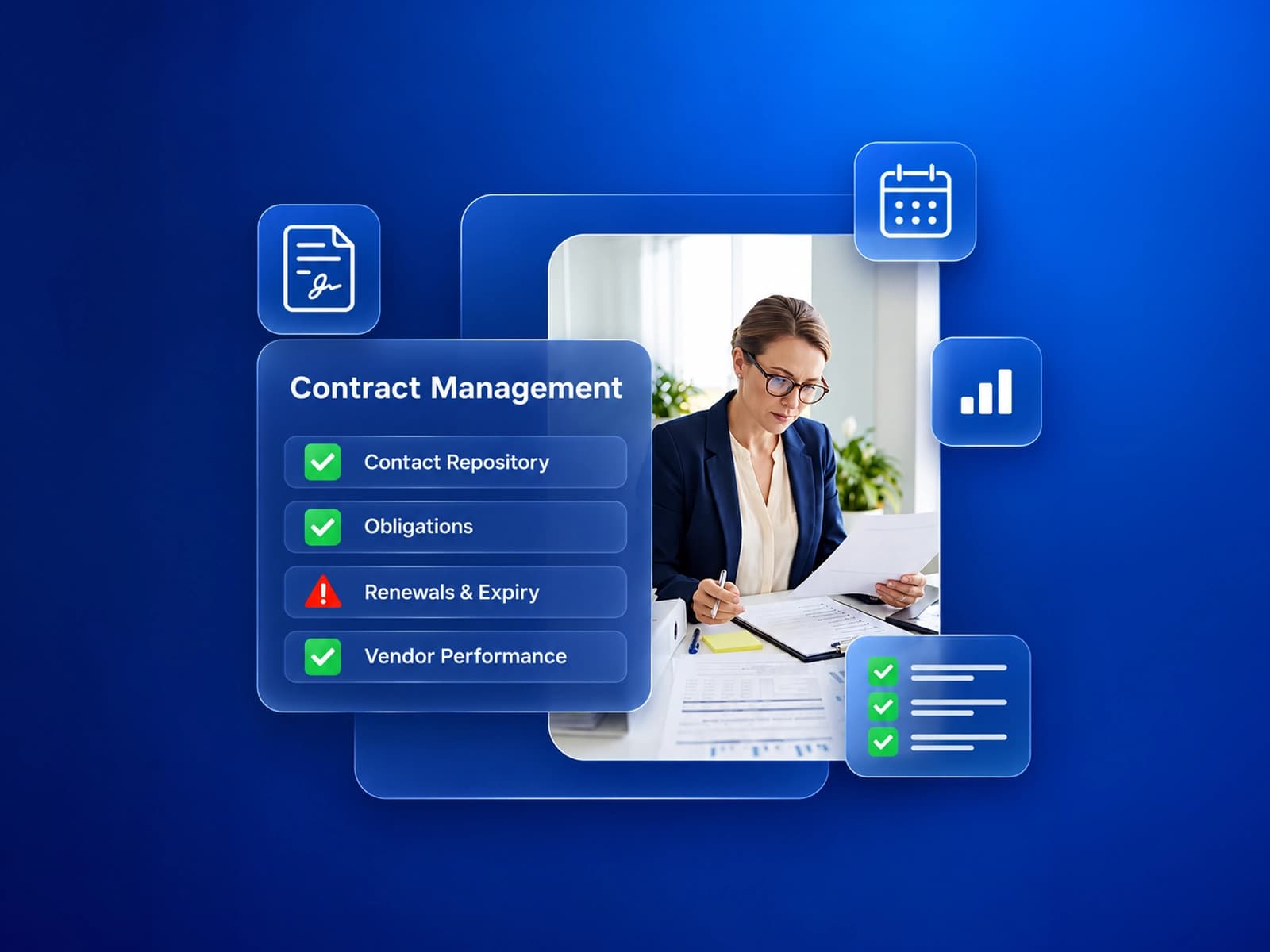

TL;DR: Most contract management challenges do not happen while a deal is being negotiated. They happen after signature, when a contract has no clear home, no clear owner and nobody comparing it with invoices, service reports and renewal dates. Research from World Commerce & Contracting puts the average loss from poor contract management at almost 9% of value a year, and a 2021 survey by EY and Harvard Law School found that only 22% of organizations systematically track contractual obligations. This guide walks through the eight contract management challenges that cost businesses the most, explains why each one happens and how to overcome it, works through an illustrative $102,000 example, and shows where to start if you can only fix one thing this quarter.
Why Contract Management Challenges Cost More Than They Seem
Contract management problems rarely announce themselves, and contract management challenges rarely look urgent. Nobody gets an alert that says “you just lost $36,000.” Instead, a price uplift is never billed, a supplier invoice is paid at the wrong rate, or a subscription renews for another year because the notice deadline passed while everyone was watching the end date. Each loss looks small and local. Added together, these contract management problems are one of the largest controllable costs in a business.
The research is consistent on the size of the problem. In August 2025, World Commerce & Contracting (WorldCC) reported that the average business loses almost 9% of value annually through poor contract management, with the best performers near 3% and the worst at 15% or more. KPMG’s benchmark data goes further, suggesting organizations may lose as much as 20 percent of expected contract value through compliance leakage, invoice errors, missed service credits and time spent chasing issues.
The timing matters too. Deloitte, citing WorldCC research, noted that the majority of lost contract value occurs in the post-signature phase. That is the key to understanding most contract management challenges. Drafting and negotiation get the attention, the lawyers and the approvals. The period after signature, when the money actually moves, often gets a shared folder and good intentions.
The eight contract management challenges below are the ones that appear again and again, in small companies and global enterprises alike. For each one, you will find what it looks like, why it happens and practical steps to overcome it. None of the fixes requires a large team. Most fixes for contract management problems start with a spreadsheet, a calendar and a decision about who is responsible.
Challenge 1: Contracts Are Scattered and Hard to Find
What it looks like. A supplier sends a renewal quote, and nobody can find the signed agreement. The final version is in someone’s inbox, an older draft is on a shared drive, and the signed amendment is in the e-signature tool. Finance asks what the payment terms are and gets three different answers.
Why it happens. Contracts arrive through many doors: sales, procurement, IT, HR, facilities and individual managers who sign their own software subscriptions. Without a rule about where signed contracts go, each team uses its own folder. A 2021 survey of more than 2,000 business leaders by EY Law and the Harvard Law School Center on the Legal Profession found that 49% lack a defined process for storing contracts after execution. Almost half of organizations, in other words, do not have a reliable answer to “where is the contract?”
How to overcome it.
- Pick one home for signed contracts. It can be a dedicated contract repository, a document management system or, for a small company, a single well-organized shared folder. What matters is that there is exactly one place.
- Make storage part of signing. The person who sends a contract for signature is responsible for filing the signed copy within a set time. Many e-signature tools can file the final copy automatically.
- Capture a minimum data set. For each contract, record the counterparty, owner, start date, end date, notice period, annual value, renewal type and payment terms. Eight fields in a spreadsheet are more useful than a thousand unlabelled PDFs.
- Run a one-time sweep. Ask every budget holder to send any signed contract that is not in the repository. Accounts payable data is a good check: any supplier you pay regularly should have a contract on file.
Challenge 2: Nobody Owns the Contract After Signature
What it looks like. The deal team negotiated the contract, celebrated the signature and moved on to the next deal. The operations team uses the supplier every day but has never read the contract. When contract management problems appear, legal, procurement and the business all assume someone else is handling it.
Why it happens. Ownership is often unclear even before signature. The same EY and Harvard Law School survey found that 59% of legal departments believe legal plays the leading role in contracting, while 56% of contracting teams believe they do. When two groups each think they lead, nobody is sure who manages the contract afterward. The handover from the people who negotiated the deal to the people who live with it is where knowledge disappears: why a clause was agreed, what the supplier promised verbally, which concessions were traded.
The UK government’s guidance for new contract managers treats this as a formal step. It lists the handover from the commercial lead to the contract manager as the first task in getting ready to manage a contract, alongside making sure obligations and responsibilities for both sides are understood.
How to overcome it.
- Name a contract owner for every contract. One person, not a team. The owner does not have to do everything, but they are accountable for the contract working as agreed.
- Name an obligation owner for each important obligation. The contract owner might be in IT, while the obligation to apply a volume discount sits with accounts payable and the obligation to send a quarterly report sits with the supplier manager.
- Hold a short handover meeting. Thirty minutes between the negotiator and the contract owner covers the key terms, the commercial intent, any side promises and the dates that matter. Write down the outcome in the contract record.
- Reassign when people leave. When an owner changes role, their contracts go on the exit checklist. An orphaned contract is a common source of missed renewals.
Challenge 3: Contract Obligations Are Not Tracked
What it looks like. The contract says the customer’s price rises by 4% each year, but nobody updates the billing system. The supplier must provide an insurance certificate every year, but nobody asks for it. The company must give 30 days’ notice before changing a data processor, but the IT team does not know that clause exists.
Why it happens. Contracts are written as legal documents, not to-do lists. Contract obligations are spread across clauses, schedules and amendments, often in language that is hard to turn into action. The EY and Harvard Law School survey found that only 22% of organizations systematically track contractual obligations. The other 78% rely on memory, goodwill and luck.
Deloitte’s UK legal practice makes the point that post-signature is more than obligation management: it is commercial management of the value flowing in and out of the contract. That is true, but you cannot manage the value of contract obligations you have not written down.
How to overcome it.
- Build an obligation register. For each important contract, list the contract obligations in plain language: what must happen, who must do it, by when and what evidence shows it was done.
- Separate your obligations from theirs. Track both what you owe (payments, notices, data, reports) and what the other side owes you (discounts, service levels, credits, deliverables). Most contract value leakage sits in the second list of contract obligations.
- Link each obligation to its clause. When a question comes up, the owner should be able to see the exact wording rather than a summary of a summary.
- Review the register when anything changes. An amendment, a renewal or a price change should trigger an update to the contract obligations, not just a new PDF.
For a deeper look at the discipline, see what contract obligation management involves.
Challenge 4: Renewal and Notice Deadlines Slip Past
What it looks like. A software subscription renews automatically for another year at a higher price. The team stopped using the tool six months ago. By the time anyone notices, the notice deadline has passed and the money is committed.
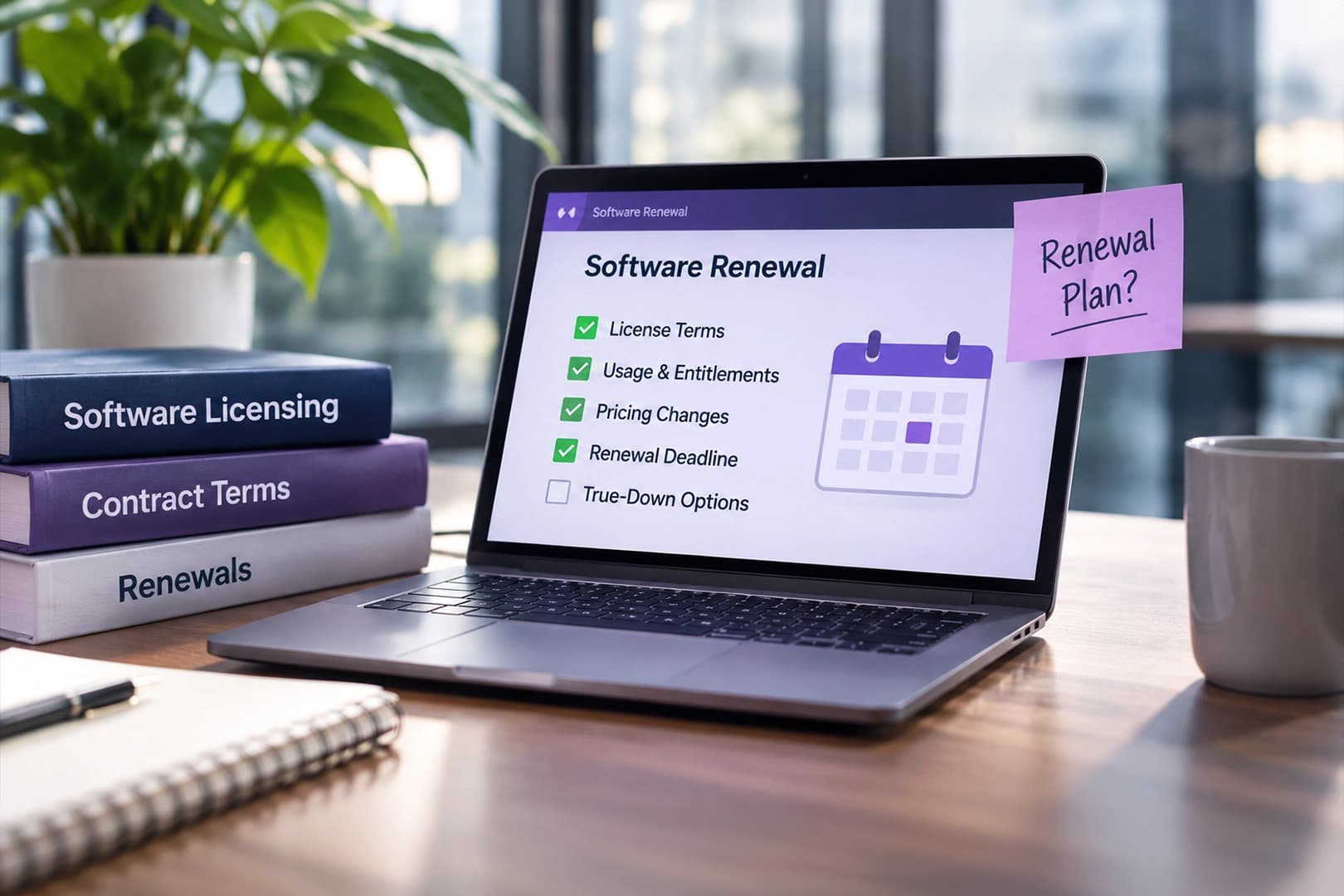
Why it happens. Most people remember end dates. Far fewer remember notice dates. Deloitte observed that many companies track the parties and the end dates of their contracts but not the notice period required to stop an auto-renewal. An automatic renewal clause with a 90-day notice period means the real decision date is three months before the date on everyone’s calendar.
The cost of missed contract renewals has also grown. Gartner research published in October 2025 found that enterprise SaaS costs are often increasing by 10% to 20% or more during contract renewal, which far exceeds IT budget growth. Missing a notice deadline no longer just means another year at the same price. It often means another year at a higher one, without the leverage to negotiate.
How to overcome it.
- Record the notice date, not just the end date. Calculate it on the day of signature and put it in the contract record.
- Set reminders at 90, 60 and 30 days before the notice date. Send them to the contract owner and a backup, so a holiday or a resignation does not break the chain.
- Decide before the deadline. For each of your upcoming contract renewals, the owner should choose to renew, renegotiate or exit, based on usage, performance and price. A renewal that happens by default is a decision nobody made.
- Keep a 12-month renewal calendar. Review contract renewals monthly with finance. It doubles as a cash forecast for contract renewals.
Our guide to contract renewal and expiry covers the decision process in more detail.
Challenge 5: Amendments and Versions Drift Apart
What it looks like. The master agreement says one price. A 2024 amendment changed it. A 2025 change order added a new service at a different rate. The billing team is still working from the original contract, and the supplier is invoicing from the amendment. Both sides believe they are right, and contract value leakage starts here.
Why it happens. Contracts change over their life, often several times. Each contract amendment is usually filed as a separate document, sometimes in a different place from the original. Over time, the “contract” becomes a stack of documents, and nobody holds a single view of what currently applies. The EY and Harvard Law School survey also found that 71% of contracts are not monitored for deviations from standard terms, so changes that weaken the original position can go unnoticed.
The UK government guidance lists the ability to justify, control and record changes to the contract as a core contract management capability. That is a useful standard for any organization: every change should have a reason, an approver and a record.
How to overcome it.
- File amendments with the original. Every amendment, change order, side letter and renewal sits in the same record as the master agreement, in date order.
- Keep a current-terms summary. After each change, update the key terms in the contract record: price, scope, dates, service levels. Some teams maintain a conformed contract that consolidates all changes into one readable version.
- Use a simple change log. Date, what changed, who approved it and which document made the change. This is the start of a contract audit trail.
- Tell the people who act on contract changes. Billing, accounts payable and service teams need to know when a price, rate or scope changes. A change nobody acts on is only half made.
Challenge 6: Invoices Do Not Match the Contract
What it looks like. A supplier bills 1,200 hours at $105 an hour. The contract rate is $95. Nobody notices, because accounts payable checks the invoice against the purchase order, and the purchase order was raised from the supplier’s quote. On the customer side, the contract allows a 4% annual uplift, but the billing system still charges last year’s price.
Why it happens. The people who pay and send invoices rarely read contracts, and the people who read contracts rarely see invoices. Standard controls like three-way matching compare the invoice, the purchase order and the goods receipt, but none of those documents is the contract. If the purchase order is wrong, the match still passes.
This is where contract value leakage becomes cash. KPMG UK described a client case where improved commercial management identified up to 10% cost-saving opportunities, much of it from contract terms not being applied in practice. The same pattern appears on the revenue side as underbilling: fees, uplifts, minimums and overages the contract allows but nobody invoices.
How to overcome it.
- Start with your largest suppliers and customers. Pick the top ten by spend or revenue and compare a sample of recent invoices with the contract’s rates, discounts, caps and uplifts.
- Load contract terms into purchasing and billing. Agreed rates and discount tiers should be in the purchase order or the billing system, not only in the PDF.
- Check price changes against the contract. Every supplier price increase should be checked against the escalation clause before it is accepted. Every customer contract with an uplift should have a billing reminder on the uplift date.
- Recover what you find. Contract value leakage from overbilling usually leads to a credit note from the supplier. Underbilling may be recoverable depending on the contract wording and governing law, so check with your legal team before reissuing invoices.
Challenge 7: Supplier Performance and Service Credits Go Unchecked
What it looks like. A hosting provider misses its uptime commitment for four months in a row. The contract entitles you to a 10% service credit each month. Nobody claims it, because nobody compared the service reports with the service levels, and the claim window closes 30 days after each month ends.
Why it happens. Of all contract management challenges, this one is the most visible in hindsight. Service levels are negotiated hard and then rarely enforced. Service reports arrive from the supplier, if at all, in a format that does not map neatly to the contract’s definitions. And most service credits are not paid automatically: the customer has to claim them, in writing, within a deadline. KPMG lists SLAs, service credits, penalties and reporting expectations among the terms that need structured oversight, and asks a blunt question that applies to most organizations: are service level agreements being enforced?
How to overcome it.
- List the service levels that carry credits. For each important supplier, record the metric, the target, the credit formula, the claim window and how to claim.
- Require reports in a usable form. If the contract allows it, ask for monthly performance reports against each service level. If it does not, add the requirement at renewal.
- Review performance monthly. A short review of service reports against targets is enough. A contract scorecard makes the pattern visible over time.
- Claim within the window. Put each claim deadline in the calendar and send the claim in writing, citing the clause. Our guide on how to claim SLA service credits walks through the steps.
Challenge 8: Tools and Data That Do Not Connect
What it looks like. The contract is in the CLM system. The invoices are in the ERP. The usage data is in the SaaS admin console. The service reports are in email. Answering a simple question, such as “are we paying this supplier what the contract says?”, means exporting four reports and spending an afternoon in a spreadsheet.
Why it happens. Contract tools, finance systems and operational systems were bought by different teams for different purposes. WorldCC found that contract-related data is scattered across 24 different systems on average. In the EY and Harvard Law School survey, 87% of organizations reported challenges with contracting technology, and tools that extract, compare and analyze contract data were used far less than basic tools.
There is a trap here. Buying a new platform rarely fixes contract management problems or contract management challenges on its own. KPMG warns that without the right structure, technology can make problems louder instead of clearer. A tool cannot assign an owner, decide on a renewal or claim a credit.
How to overcome it.
- Fix ownership and process first. Challenges 1 to 3 come before any tool decision. A tool built on an unclear process automates the confusion.
- Decide which questions matter. For most businesses: which contract renewals fall in the next 90 days, are we paying the agreed rates, are we billing everything we are owed and are suppliers meeting service levels.
- Connect data around those questions. You do not need every system integrated. You need contract terms next to invoices, billing and service data for the contracts that matter most.
- Prefer overlays to replacements. A tool that reads your existing contracts and data, and works beside your CLM, ERP and billing systems, is usually faster to adopt than one that asks you to move everything.
A Worked Example: Four Misses in One Illustrative Year
To see how these contract management challenges add up, consider an illustrative mid-sized business with $10,000,000 a year in contracted value across its supplier and customer contracts. It has no single repository, contract owners are informal and nobody compares contracts with invoices. In one year, four misses occur:
- A missed notice deadline (Challenge 4). A $48,000-a-year software subscription renews automatically because the 90-day notice deadline passed. The team had stopped using the tool. Cost: $48,000.
- An unbilled price uplift (Challenge 3). A customer contract allows a 4% annual uplift on $900,000 of annual fees. Nobody owns the obligation, so billing never applies it. Cost: $36,000 in revenue that was owed but never invoiced.
- A supplier billing above the contracted rate (Challenge 6). A services supplier bills 1,200 hours at $105 instead of the contracted $95. Cost: $12,000.
- Unclaimed service credits (Challenge 7). A hosting provider misses its service level for four months. The contract gives a 10% credit on a $15,000 monthly fee, but the claim windows close unnoticed. Cost: $6,000.

The total is $102,000, or 1.02% of contracted value. That is well below the almost 9% average WorldCC reports, because this example covers only four clauses. A real portfolio has hundreds. Every figure here came from terms already in signed contracts. Nobody had to negotiate anything new. They only had to notice.
The same example shows why the challenges compound. The missed uplift happened because nobody owned the obligation (Challenge 2). The rate error survived because invoices were never compared with the contract (Challenge 8). Fixing one challenge in isolation helps. Fixing ownership, tracking and comparison together is what changes the result and reduces contract value leakage.
How ObligaAI Helps With Contract Management Challenges
ObligaAI is a contract management platform built for the challenges that start after signature. It reads your signed contracts and amendments and turns each clause into a plain-language obligation, linked to the exact source passage with a confidence score, so your team can see what the contract actually says rather than a summary.
It then compares those obligations with the evidence: invoices, service reports, usage and delivery data. That comparison addresses several of the challenges above directly:
- Invoices that do not match the contract. Supplier leakage checks rates, quantities and scope against contracts, amendments, purchase orders, receipts and timesheets, to catch overbilling before you pay.
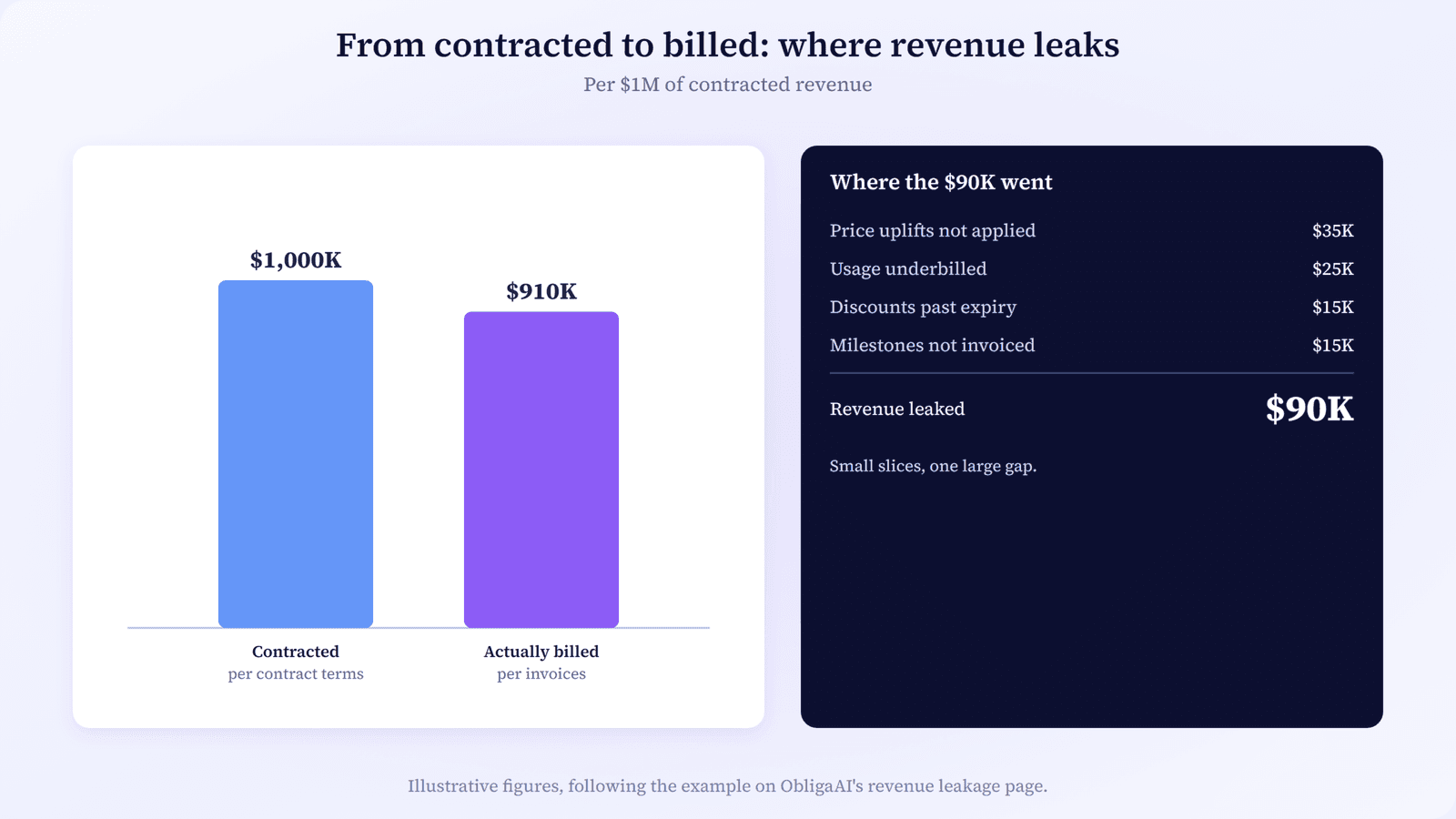
- Revenue that is owed but not billed. Revenue leakage compares fees, escalators, usage tiers, minimums, milestones and renewal terms with your invoices, so you bill everything your customers owe.
- Service credits nobody claimed. SLA leakage compares service levels with performance and shows breaches, the credit due and claim-by dates.
- Renewals and expiry. Contract expiry and renewal tracking is one of ObligaAI’s use cases, alongside software licensing and contract Q&A with source references.
ObligaAI is advisory-first. Every finding comes with the clause attached, and nothing changes a payment, an invoice or a contract until someone on your team approves it. It works beside your existing CLM, ERP and billing tools rather than replacing them, which matters for Challenge 8. Security details, including encryption, role-based access, audit trail and data ownership, are on the trust page.
Where to Start: Prioritize Contracts by Value and Risk
Eight contract management challenges is a lot to fix at once. The good news is that you do not need to fix them for every contract. Most of the value, the risk and the contract value leakage sit in a small share of contracts.
The case for focus is strong. Deloitte reported that almost 70% of contract management costs are incurred post-award, yet only 39% of organizations were focused on improving post-award processes. Effort is already being spent after signature. The question is whether it is spent where it counts.
Public-sector guidance uses tiering for this. The UK government guidance asks contract managers to allocate each contract to a tier under a governance framework, and KPMG recommends supplier segmentation so the highest-value and highest-risk relationships receive the right level of attention. A simple version works for any business:
| Tier | Which contracts | What to do |
|---|---|---|
| Tier 1 | Top contracts by annual value, plus any that are business-critical or hard to replace | Named owner, full obligation register, monthly invoice and performance checks, renewal decision 90+ days ahead |
| Tier 2 | Mid-value contracts and those with auto-renewal or price escalation clauses | Named owner, key dates and prices recorded, quarterly checks, renewal reminders |
| Tier 3 | Low-value, low-risk contracts | In the repository with basic data, renewal reminder, annual review |
Start with Tier 1. For most businesses, that is 10 to 30 contracts. Fix contract management challenges 1 to 4 for those contracts first: find them, assign owners, record contract obligations and set renewal reminders. Then add invoice and performance checks. Move down the tiers as the habits settle.

A Quick Self-Assessment for Your Contract Portfolio
Use these questions to find which contract management challenges affect your business most. Answer for your ten largest contracts. Each “no” points to one of the contract management problems to work on.
| Question | If the answer is no |
|---|---|
| Can you find the signed copy and every amendment in under five minutes? | Challenge 1 and Challenge 5 |
| Does each contract have one named owner who knows they own it? | Challenge 2 |
| Is there a written list of what each side must do, with dates? | Challenge 3 |
| Do you know the notice deadline, not just the end date? | Challenge 4 |
| Have you compared recent invoices with contracted rates and uplifts? | Challenge 6 |
| Have you checked service reports against service levels in the last quarter? | Challenge 7 |
| Can you see contract terms and invoice data side by side? | Challenge 8 |
If you answered “no” to three or more, you are in good company: the EY and Harvard Law School survey suggests most organizations would. Pick the challenge with the biggest money attached, usually renewals or invoice checks, and start there.
What Fixing These Challenges Will Not Do
Honest limits matter, because overpromising is one of the reasons projects to fix contract management challenges stall.
- It will not fix a bad contract. If the contract has weak service levels or no price cap, better management cannot add them. It can only make sure your contract obligations are met and you use what you negotiated, and give you evidence for the next negotiation.
- It will not remove the need for judgment. Whether a credit is due, an uplift applies or a renewal notice was valid depends on the contract wording and the governing law. This guide is not legal advice; involve your legal team for disputes.
- It will not happen without effort. A register nobody updates goes stale quickly. Ownership and a monthly rhythm matter more than the tool.
- It will not repair every relationship. Some problems are about trust, not tracking. A 2019 Harvard Business Review article argued that traditional contracts do not work well for complex, long-term relationships and proposed relational contracts built on shared guiding principles. Tracking obligations helps, but it does not replace a working relationship with key suppliers and customers.
- It will not recover everything. Some losses are found too late, after claim windows close or limitation periods run. The goal is to find more, sooner.
Frequently Asked Questions About Contract Management Challenges
What are the biggest contract management challenges?
The biggest contract management challenges are scattered contracts, unclear ownership after signature, untracked contract obligations, missed renewal and notice deadlines, amendments that drift from the original, invoices that do not match the contract, unchecked supplier performance and disconnected tools. Most of them occur after the contract is signed, which is where research suggests most contract value is lost.
Why is contract management so difficult?
Contract management challenges start because contracts are legal documents, but their value is delivered through operations, invoices and service. The people who negotiate contracts are rarely the people who manage them, and the data needed to check a contract sits in many systems. Without clear owners and a simple process, contract obligations and other important terms are forgotten once the contract is filed.
How do you overcome contract management challenges?
Start by putting every signed contract in one place with a minimum set of key data. Name an owner for each contract and important obligation. Record notice deadlines and set reminders. Then compare your largest contracts with invoices and service reports. Focus on the highest-value contracts first and expand as the habits take hold.
What is the most expensive contract management problem?
It varies by business, but missed renewal deadlines and invoices that do not match contracted terms are usually the largest. A missed notice deadline commits a full year of spend, often at a higher price. Invoice mismatches repeat every billing cycle until someone checks them, so they accumulate quietly.
Do small businesses face the same contract management challenges?
Yes, often more sharply. A small business may have fewer contracts, but a single unwanted auto-renewal or unbilled uplift is a larger share of its budget. Small teams can overcome most contract management challenges with a shared folder, a spreadsheet register, calendar reminders and a named owner for each contract.
Do you need CLM software to fix contract management problems?
Not to start. Process and ownership come first, and they solve most contract management problems. Software becomes valuable as volume grows, especially when contracts, amendments, invoices and service data sit in different systems and comparing them by hand takes too long to do consistently. Tools that work beside existing systems are usually easier to adopt.
How often should contracts be reviewed?
It depends on value and risk. A practical rhythm is monthly checks for your most important contracts, quarterly reviews for mid-value contracts and an annual review for low-value ones, plus a review whenever a renewal, amendment or price change is due.
What is contract value leakage?
Contract value leakage is the gap between what a contract entitles you to and what you actually receive or bill. It includes supplier overbilling, discounts not applied, uplifts not invoiced, service credits not claimed and unwanted renewals. It is the financial result of the contract management challenges described in this guide.
Overcome Your Contract Management Challenges With ObligaAI
Every one of these contract management challenges has the same root: a signed contract that nobody is actively comparing with what is really happening. You do not need to fix all eight at once. Find your most valuable contracts, give them owners, record their contract renewals and deadlines, and check them against your invoices. The money you recover is money your contracts already said was yours.
If you want help with the comparison, ObligaAI reads your signed contracts, turns them into tracked obligations and checks them against invoices, service reports and renewal dates, raising each finding with the clause attached for your team to approve. Start free with ObligaAI, with no credit card required, or start a conversation with the team about the contract management challenges that matter most to your business.