
TL;DR: Signing a contract is the start of its value, not the end. Prices, discounts, uplifts, service credits, renewal deadlines and delivery promises all play out after signature, and that is where most contract value is quietly lost. Research from World Commerce & Contracting puts the average loss at almost 9% of value a year, and Deloitte notes that most of it happens after signing. This guide explains what post-signature contract management covers, works through an illustrative $90,000 example, shows why it matters for a five-person startup as much as a global enterprise, and gives a 30-day plan to start.
Where Contract Value Is Really Won or Lost
Most companies put their contract effort into the deal. Legal reviews the terms, finance checks the price, someone chases signatures, and when the contract is finally signed, everyone moves on. The PDF goes into a shared drive, an inbox or a contract repository, and the next time anyone reads it is often when something has already gone wrong.
That habit is expensive. In an April 2022 article, Deloitte cited World Commerce & Contracting (WorldCC) research that 9.2 percent of annual contract value is lost through poor management across the whole life cycle, with the majority of that lost value occurring in the post-signature phase. The same article makes a point every finance team will recognize: many companies track the parties and the end dates, but not the notice period needed to stop an auto-renewal.
The number has barely moved. In August 2025, WorldCC reported that the average business loses almost 9% of value annually through poor contract management. The best performers lose about 3%; the worst lose 15% or more. The gap between those two groups is not better negotiating. It is what happens after the contract is signed.
This is what post-signature contract management is about: making sure the value you negotiated actually arrives. That includes the discount you agreed, the price uplift your customer owes, the service credit your vendor promised, and the deadline that decides whether a contract renews for another year. None of these happen by themselves. Each one is a promise in a signed document that someone has to notice, act on and check.
The rest of this guide explains what that work involves, why it matters at every size and stage of a business, and how to start without a large team or budget.
What Post-Signature Contract Management Covers
Post-signature contract management is the work of running a contract from the day it is signed until it ends or renews. It turns the promises in the document into tracked contract obligations, with owners, dates and evidence, and it checks that both sides actually deliver.
The five jobs that start at signature
Whatever the size of the company, the same five jobs appear once a contract is signed:
- Capture the terms. Record the parties, start and end dates, notice periods, prices, discounts, caps, payment terms and service levels in a form people can search, not just a PDF.
- Assign owners to contract obligations. Every obligation needs a person responsible for it: a delivery date, a report, an insurance certificate, a price review. An obligation owner is the difference between a promise that is kept and one that is merely written down.
- Watch the dates. Contract renewals, termination notice deadlines, price review dates, claim windows for credits and rebates, and milestone dates all need reminders well before they arrive.
- Compare promises with reality. Supplier invoices should match agreed rates and discounts. Customer invoices should include every fee, uplift and overage the contract allows. Service reports should be checked against service levels. Any gap is contract value leakage.
- Manage change. Amendments, change orders, renewals and disputes all modify what the contract means. Each change has to update the record, or the record quietly becomes wrong.
Deloitte’s UK legal practice puts it bluntly: post-signature is more than obligation management. It is commercial management, including the money that flows in and out because of the contract. A tidy obligation register is a good start, but the value appears when the register is compared with invoices, usage and service data.
Post-signature versus post-award contract management
The two terms describe the same phase. “Post-award contract management” is common in procurement and government contracting, where a contract is awarded to a supplier after a tender. “Post-signature contract management” is more common in commercial and legal teams and covers both buy-side and sell-side contracts. In practice, both mean managing contract obligations, changes, performance and renewals after the deal is done. This guide uses post-signature contract management because it applies equally to supplier contracts and customer contracts.
It also helps to separate it from the related idea of contract obligation management, which focuses on finding obligations and assigning owners. Post-signature contract management includes that, plus the financial checks, renewals and changes that sit around it.
How Post-Signature Contract Management Evolved
For most of business history, contract management meant drafting and negotiating. Once signed, contracts were filed. Large organizations employed contract managers for big supplier relationships and government programs, but the average commercial contract was managed by memory: someone remembered the renewal date, or didn’t.
Three shifts changed that.
First, the number of contracts exploded. Software moved to subscriptions, outsourcing spread, and even small companies now sign dozens of SaaS, cloud, logistics, marketing and customer agreements a year. Each one carries its own renewal date, price terms and service levels.
Second, research put a number on the loss. WorldCC’s value-erosion research gave finance teams a figure to work with, and consultancies began to show where the cost sits. In May 2022, Deloitte reported that almost 70 percent of the costs of contract management are incurred post-award, yet only 39 percent of organizations surveyed were focused on improving their post-award processes, and only 34 percent were working on more robust approaches to obligation management. In other words, most of the spend is after signature, but most of the attention is still before it.
Third, the pandemic tested every contract at once. In 2020, companies had to find force majeure clauses, notice terms, minimum commitments and supply obligations across thousands of agreements within days. Many discovered they could not. Deloitte’s 2022 analysis describes this as the moment it became clear that post-signature is where contract value is truly won or lost.
Thinking about contracts has also moved. A 2019 Harvard Business Review article by David Frydlinger, Oliver Hart and Kate Vitasek argued that traditional contracts don’t work well for complex, long-term relationships and proposed relational contracts with shared guiding principles. Whether or not a company adopts that model, the idea behind it applies everywhere: a contract is a living relationship that needs attention after signature, not a document to file and forget.
A Worked Example: Four Clauses in One Illustrative Year
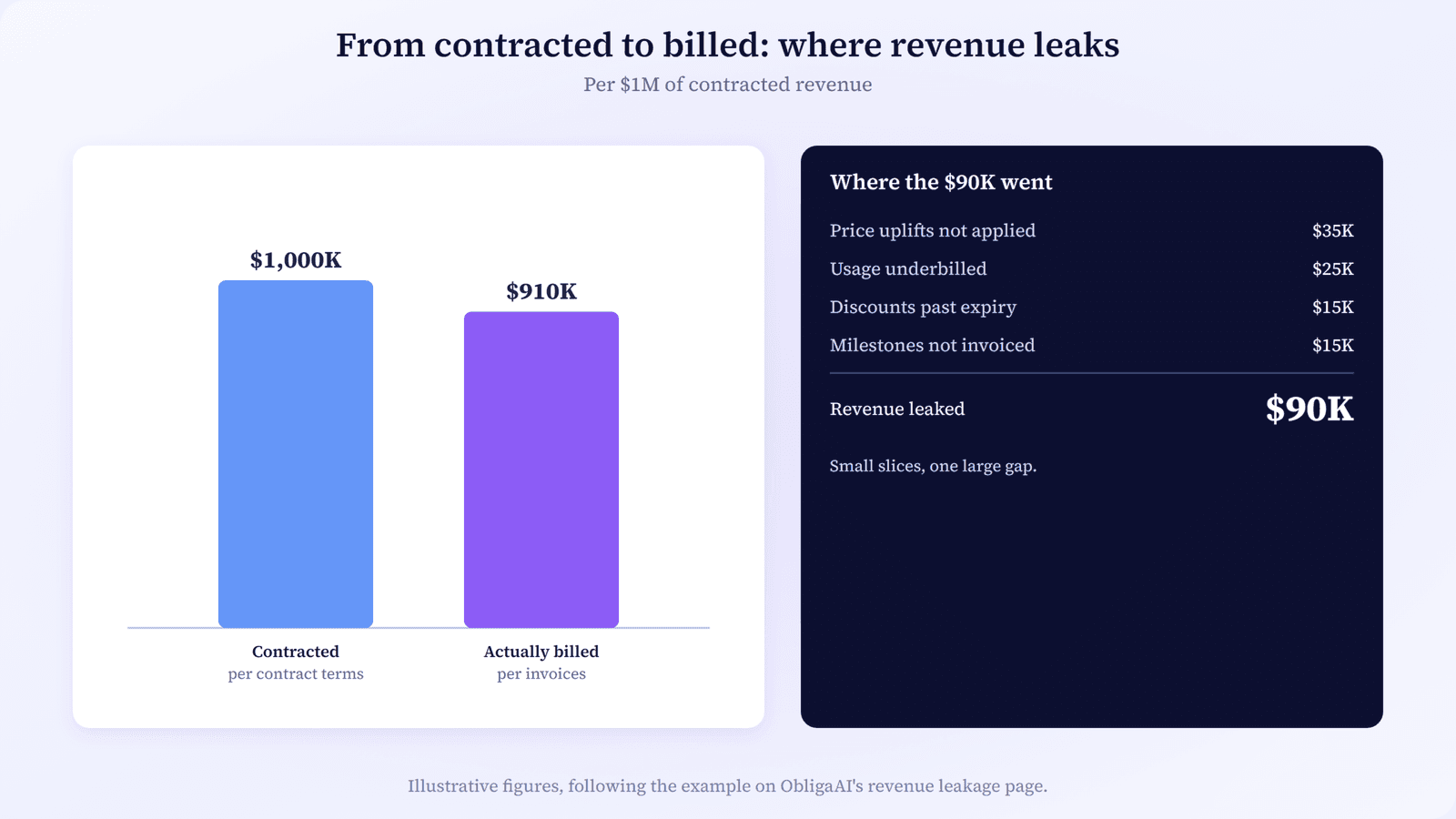
Statistics are easier to accept than to act on, so here is a simple, illustrative example. Imagine a growing business with $4,000,000 a year in contracted value across its supplier and customer contracts. It has no one assigned to post-signature contract management. Over one year, four ordinary clauses go unwatched:
- A missed renewal notice. A $36,000-a-year analytics tool renews automatically unless the company gives 60 days’ notice. The team stopped using it months ago, but nobody owned the contract, and the notice date passed. Cost: $36,000 for another year of a tool nobody uses.
- A customer price uplift never billed. An $800,000 customer contract allows a 3% annual uplift. Billing kept invoicing the old price because the uplift was written in the contract, not in the billing system. Cost: $24,000 of revenue not invoiced.
- A supplier volume discount never applied. A logistics contract promises a lower rate once volume passes a threshold. The supplier kept invoicing the standard rate, and accounts payable had no way to know. Cost: $18,000 overpaid.
- Service credits never claimed. A hosting provider missed its uptime commitment several times. The contract allowed credits, but only if the customer claimed them within a set window. Nobody did. Cost: $12,000 of credits forgone.

Together, these four misses cost $90,000, or 2.25% of contracted value. None of them involved a dispute, a bad negotiation or fraud. Every dollar was already written into a signed contract. It was lost because nobody compared the contract with what happened afterwards.
Scale changes the size of the number, not the pattern. Announcing its August 2025 research, WorldCC noted that for a billion-dollar business, almost 9% of revenue means more than $90 million disappearing from the bottom line each year. For the illustrative company above, the same four clause types cost $90,000. For a five-person startup, a single missed auto-renewal can be the difference between hitting a quarter’s budget or not.
The first miss is the easiest to prevent, and it shows why dates matter as much as money. The contract was signed on 1 January 2026 and renews on 1 January 2027. With a 60-day notice period, the real deadline is 2 November 2026, not the renewal date most people remember.

A calendar entry set on the day of signature would have saved $36,000. That is post-signature contract management at its simplest.
Why It Matters at Every Business Size and Stage
Post-signature contract management is often described as an enterprise discipline, with dedicated teams and large systems. The value at stake is real for enterprises, but the contracts that hurt smaller companies are often the same ones, with less room to absorb the loss.
Early-stage companies: protect cash and avoid surprise renewals
A startup’s contracts are few but important: cloud hosting, a handful of SaaS tools, a lease, early customer agreements and perhaps investor side letters. Each contract can tie up meaningful cash, and the team rarely has a lawyer or contract manager.
The most common early-stage losses are auto-renewals and price increases. Gartner research has found that enterprise SaaS costs are often increasing by 10% to 20% or more at contract renewal, far faster than IT budgets grow. For a startup on a fixed runway, catching contract renewals before the notice deadline is cash management.
Startups that sell subscriptions to consumers also have obligations of their own. In the United States, the Restore Online Shoppers’ Confidence Act makes it unlawful to charge a consumer for goods or services sold online through a negative option feature unless the seller meets disclosure, consent and cancellation conditions. Whether and how these rules apply depends on the business model, the contract wording and the governing law, so take legal advice, but the point is clear: your own customer contracts create obligations too.
What to do at this stage: keep every signed contract in one folder, record contract renewals and notice dates in a shared calendar, and name one person as the owner of each contract.
Scale-ups: catch revenue that never reaches an invoice
As a company grows, it signs larger customer contracts with negotiated terms: annual uplifts, usage tiers, minimum commitments, implementation milestones and custom discounts. Sales agrees the terms; billing runs on a standard price list. The gap between the two is where revenue leaks.
The illustrative 3% uplift in the example above is typical. ObligaAI’s own revenue leakage page gives an illustrative case of $200 a month unbilled, about $2,400 over a year from one clause. Multiply that by dozens of customer contracts and it becomes material. Scale-ups also face more auditors, investors and board members asking whether revenue matches contracts, so the habit of checking invoices against contract terms pays twice.
What to do at this stage: build a short register of every customer contract with non-standard terms, and review it against billing before each invoice run.
Mid-market businesses: control supplier spend and renewals
Mid-sized businesses typically have hundreds of supplier contracts, several departments signing them, and no central owner. Discounts, rebates, rate caps and volume tiers are negotiated by procurement, then forgotten by accounts payable, which pays what is invoiced.
This is where supplier-side contract value leakage grows. Discounts and rate caps that procurement fought for are only worth something if invoices reflect them, and in many mid-sized companies nobody checks. The fix is not more negotiation; it is checking what was invoiced against what was agreed.
Regulation is also moving. The FTC’s 2024 click-to-cancel rule was vacated by a federal appeals court in 2025, the FTC has since moved to revisit the topic, and many states have their own automatic-renewal laws. A mid-market company that both buys and sells subscriptions needs to track renewal terms on both sides.
What to do at this stage: centralize contracts, give each supplier contract an owner, and check the top 20 suppliers’ invoices against their contracted rates every quarter.
Large enterprises: turn scale into a system
Enterprises have the most contracts, the most systems and, in absolute terms, the most at stake. The challenge is not knowing that post-signature contract management matters; it is doing it across thousands of agreements, amendments and business units. Deloitte has reported that fewer than 30 percent of organizations have centralized or center-led post-signature contract management resources, which means most still rely on scattered teams.
At this scale, the work becomes a system: standard obligation data, owners in every business unit, regular reconciliation of invoices with contract terms, service-level tracking, and reporting that shows value recovered. The habits are the same as a startup’s. The difference is volume, and the number of contract obligations to track.
Advantages of Managing Contracts After Signature
The case for post-signature contract management is not only about avoiding losses. Done well, it improves how the business runs.
- Recovering money already owed. Discounts, uplifts, rebates and service credits are written into signed contracts. Claiming them is not a negotiation; it is enforcement of terms both parties already agreed. KPMG UK described a client case where improved commercial management identified up to 10% cost-saving opportunities on roughly £10 million of addressable annual spend, with plans to reclaim about £1 million of historic leakage. Results vary, but the source of the savings is the same: checking what was invoiced against what was agreed.
- Fewer unwanted renewals. Tracking notice periods, not just end dates, gives the team a real decision point before contract renewals instead of automatic extensions.
- Stronger negotiations. When renewal arrives, the team knows how much was used, whether service levels were met and what was paid. That evidence changes the conversation with suppliers and customers.
- Cleaner audits and reporting. A record of each obligation, who owned it and what happened makes audits, due diligence and board reporting faster and more credible.
- Better relationships. Most counterparties prefer a partner who raises issues early with the clause in hand over one who discovers problems at renewal.
- Effort where cost already sits. With almost 70% of contract management costs incurred after award, improving this phase targets the part of the process that already consumes the most time.
There is also a simpler benefit. When contracts are understood, people can answer basic questions quickly: Can we terminate? What notice do we need to give? Are we allowed to raise this price? Is that credit claimable? Teams that cannot answer those questions spend hours searching PDFs, or they guess.
How ObligaAI Helps You Manage Contracts After Signature
Everything above depends on one difficult step: knowing what each signed contract says and comparing it with what actually happens. For most teams, that information is spread across contracts, amendments, invoices and service reports in different systems.
ObligaAI is built for that post-signature step. It reads signed contracts and amendments, turns each clause into a plain-language obligation linked to the exact source passage, and gives each reading a confidence score so a person can check it. Its workflow starts when contracts sync on execution, then moves through tracking obligations, spotting risks and missed value, taking action and seeing the impact.
It then compares those obligations with real evidence, in three areas that match the losses in our example:
- Supplier leakage. ObligaAI’s supplier leakage product compares supplier invoices with your contracts, amendments and delivery evidence. It is designed to catch issues such as missed volume tiers and uplifts past the cap, the kind of discount our illustrative logistics supplier never applied.
- Revenue leakage. The revenue leakage product compares customer contracts with what was actually invoiced, so fees, escalators, usage tiers, minimums and milestones are billed as agreed. Our illustrative 3% uplift is exactly this kind of gap.
- SLA leakage. The SLA product compares service performance with the SLA terms in your contracts, so you can claim the service credits you have already earned before the claim window closes.
Contract expiry and renewals are one of ObligaAI’s core use cases, alongside software licensing and contract Q&A, so notice deadlines like the 2 November date in our timeline are visible in advance. For a deeper look at that topic, see our guide to contract renewal and expiry decisions.
Two design choices matter for teams of any size:
Advisory first. ObligaAI raises findings with the clause attached; people decide what to do. Nothing changes a payment, an invoice or a contract until someone approves it.
An overlay, not a replacement. It works beside your existing contract repository, ERP and billing tools rather than replacing them. On security, ObligaAI’s trust page states that data is encrypted in transit and at rest, access is role-based, and every finding and approval is recorded in an audit trail.
That combination suits a startup with a few dozen contracts as much as an enterprise with thousands: start small, see what your own contracts are owed, and grow from there. ObligaAI is free to start, with no credit card.
A 30-Day Plan to Start Post-Signature Contract Management
You do not need a new system or a new team to begin. This plan works in a spreadsheet and scales into any tool later.
Days 1-5: Gather the contracts. Collect every signed contract, amendment and order form into one place. Start with the contracts that matter most: the 20 largest suppliers by spend, the 20 largest customers by revenue, and every contract that renews automatically.
Days 6-10: Capture the key terms. For each contract, record the counterparty, start and end dates, renewal type, notice period and the date notice must be given, price and any uplift or cap, discounts and volume tiers, service levels and credit claim windows, and payment terms.
Days 11-15: Assign owners. Give every contract a named owner, and give the most important contract obligations named owners too. The owner does not have to do all the work, but they are responsible for making sure it happens.
Days 16-20: Set the dates. Put every notice deadline, price review and claim window in a shared calendar with reminders at 90, 60 and 30 days. Make sure reminders go to a team, not only to one inbox.
Days 21-25: Compare contracts with invoices. For your top suppliers, check the last three invoices against contracted rates and discounts. For your top customers, check that every uplift, overage and minimum has been billed. Note every difference, with the clause that supports it.
Days 26-30: Act and review. Raise the differences with the counterparty, in writing, with the clause attached. Decide on all contract renewals due in the next 120 days. Then schedule a monthly review so the register stays current.
Most teams find something in the first month: an expired discount, a missed uplift, a renewal nobody wanted. That first finding is usually enough to justify the habit.
Limits and Honest Trade-Offs of Post-Signature Work
Post-signature contract management is valuable, but it is not free, and it does not solve every problem.
- It takes ongoing effort. A register that nobody updates becomes misleading. The benefit depends on owners keeping contract obligations, dates and amendments current.
- Data is fragmented. WorldCC found contract-related data scattered across 24 different systems. Matching a clause to the right invoice line or service report is often the hardest part of the job, with or without software.
- Contracts are hard to read. WorldCC also found that almost 90% of business users find contracts difficult or impossible to understand. Plain-language summaries help, but someone still has to read the clause when the stakes are high.
- Interpretation depends on wording and law. Whether a credit is claimable, a price increase is permitted or a notice is valid depends on the exact contract wording and the governing law. This guide is not legal advice; involve counsel for disputes and significant decisions.
- Small teams have limited time. In a ten-person company, the contract owner is also the finance lead, the office manager and the person who orders the coffee. Focus on the few contracts that carry the most money or risk rather than trying to track everything at once.
- Recovery is not guaranteed. Some counterparties will dispute a claim, and some value cannot be recovered after a deadline has passed. The goal is to catch issues earlier, not to promise a fixed return.
These limits are reasons to start small and stay consistent, not reasons to wait.
Post-Signature Contract Management Is a Habit, Not a Headcount
The most important idea in this guide is simple: the value of a contract is delivered after it is signed. Every discount, uplift, credit and renewal decision is written into a document, but none of them happen unless someone is watching.
That is true for a five-person startup with fifteen contracts and for a global company with fifty thousand. The startup risks a surprise renewal it cannot afford; the scale-up risks revenue that never reaches an invoice; the mid-market company risks paying suppliers more than it agreed; the enterprise risks all three at a scale that turns percentages into millions. Research from WorldCC, Deloitte and KPMG points the same way: most contract value is lost after signature, and the organizations that manage this phase lose far less.
The habits are the same at every stage: keep contracts in one place, capture the terms that matter, give every obligation an owner, watch the dates, compare contracts with invoices and service data, and act in writing with the clause attached. Start with the largest contracts and the nearest deadlines, and build from there.
When you are ready to make that easier, ObligaAI reads your signed contracts, tracks contract obligations and renewal dates, and flags supplier overbilling, unbilled revenue and unclaimed service credits with the clause attached, while your team stays in charge of every decision.
Frequently Asked Questions About Post-Signature Contract Management
What is post-signature contract management?
Post-signature contract management is the work of running a contract after it is signed. It includes recording key terms, assigning owners to contract obligations, tracking renewal and notice dates, comparing invoices and service performance with what the contract says, and managing amendments and renewals. Its purpose is to make sure the value negotiated in the contract is actually delivered.
Why is post-signature contract management important?
Most contract value is realized, or lost, after signature. WorldCC research reported in 2025 that the average business loses almost 9% of value annually through poor contract management, and Deloitte notes that most of that loss happens after signing. Missed renewals, unapplied discounts, unbilled uplifts and unclaimed credits are common causes.
Does a small business need post-signature contract management?
Yes, although it can be simple. A small business may have only a few dozen contracts, but a single unwanted auto-renewal or price increase can hurt more than it would at a large company. Keeping contracts in one place, recording notice dates in a shared calendar and naming an owner for each contract covers most of the risk.
When should a startup start managing contracts after signing?
From the first contract that renews automatically or carries a price change. In practice, that is usually the first SaaS subscription or cloud agreement. Setting a calendar reminder for the notice deadline on the day of signature takes minutes and prevents the most common early-stage loss: paying for another year of something nobody uses.
What is the difference between post-signature and post-award contract management?
They describe the same phase. Post-award contract management is the term used more often in procurement and government contracting, where a contract is awarded after a tender. Post-signature is more common in commercial and legal teams and covers both supplier and customer contracts. Both cover obligations, performance, changes and renewals after the deal is done.
What are the most common post-signature contract mistakes?
The most common mistakes are tracking end dates but not notice deadlines, failing to bill agreed price uplifts or usage overages, paying supplier invoices without checking contracted rates and discounts, missing service credit claim windows, and failing to update records after amendments. Each one leaves value written in the contract unrealized.
How do you measure contract value leakage?
Compare the value each contract entitles you to with the value you actually realized. For supplier contracts, that means agreed rates, discounts and credits against what was invoiced and paid. For customer contracts, it means contracted fees, uplifts and minimums against what was billed. Total the differences, which are your contract value leakage, and express them as a share of contracted value.
Do I need software for post-signature contract management?
Not to start. A shared folder, a spreadsheet register and a calendar are enough for a small number of contracts. Software becomes useful as volume grows, when contracts, amendments, invoices and service data sit in different systems and comparing them by hand takes too long to do consistently.
Start Managing Your Signed Contracts With ObligaAI
Your signed contracts already say what you are owed and what you owe. The question is whether anyone is checking. Start with your largest contracts and your next renewal deadlines, compare them with your invoices, and see what turns up.
If you want help, ObligaAI turns signed contracts into tracked obligations, keeps renewal dates in view and compares contracts with invoices and service data, raising every finding with the clause attached for your team to approve. Start free with ObligaAI, with no credit card required, or start a conversation with the team about the contracts that matter most to your business.