
TL;DR: Revenue leakage is the gap between what your customer contracts say you earned and what you actually invoiced and collected. It rarely comes from one big mistake. It comes from small, repeated misses: a price uplift never applied at renewal, usage billed from a stale report, a discount that ran past its end date, a minimum commitment shortfall never invoiced, a milestone delivered but not billed, late payment interest never charged. This guide shows where revenue leakage hides, how to calculate each type with worked examples, how to run a revenue leakage audit across your contracts, and how to recover underbilling without damaging the customer relationship.
Why Revenue Leakage Is a Contract Problem
Most companies treat revenue as a sales problem. Win more deals, raise more prices, grow the pipeline. But a large share of the revenue a business is entitled to is already won. It sits in signed contracts, waiting to be billed correctly.
Revenue leakage happens after the signature. Sales negotiates a 5% annual uplift, a usage overage rate, a 12-month introductory discount and a minimum annual commitment. Then the contract is filed, the billing system is set up once, and nobody checks again whether the invoices still match the terms.
The cost of that gap is larger than it looks, because price is one of the strongest profit levers a company has. In their 1992 Harvard Business Review article, McKinsey’s Michael Marn and Robert Rosiello argued that the right price can boost profit faster than increasing volume will. Revenue leakage is the reverse of that lever: price you agreed and then failed to collect.
The good news is that contract revenue leakage is usually recoverable and almost always preventable. The terms are written down. The invoices exist. The work is comparing the two, consistently. This guide is written for finance and the CFO office, billing and revenue operations, sales operations, and legal and contracts teams who want to do that comparison well.
What Revenue Leakage Means in Practice
In this guide, revenue leakage means revenue a business is entitled to under its customer contracts but does not invoice or collect. ObligaAI’s glossary covers revenue leakage and contract revenue leakage as terms in their own right. Three related ideas are worth keeping separate.
- Underbilling. Invoicing less than the contract allows. See underbilling. This is the core of revenue leakage.
- Unbilled revenue. Revenue earned but not yet invoiced. Some unbilled revenue is normal timing; it becomes leakage when it never gets invoiced at all.
- Uncollected revenue. Invoiced but never paid, or paid late without the interest the contract or law allows.
Revenue leakage is not the same as discounting. A discount you chose to give is a commercial decision. A discount that keeps applying after the contract says it should end is leakage. The test is simple: does the invoice match what the contract says the customer owes today?
It is also not a revenue recognition question. Accounting rules decide when revenue is recognised in the books. Revenue leakage is about whether the invoice was raised for the right amount at all. A company can recognise revenue perfectly and still leak it. For background on the accounting side, see revenue recognition.
Where Revenue Leakage Hides
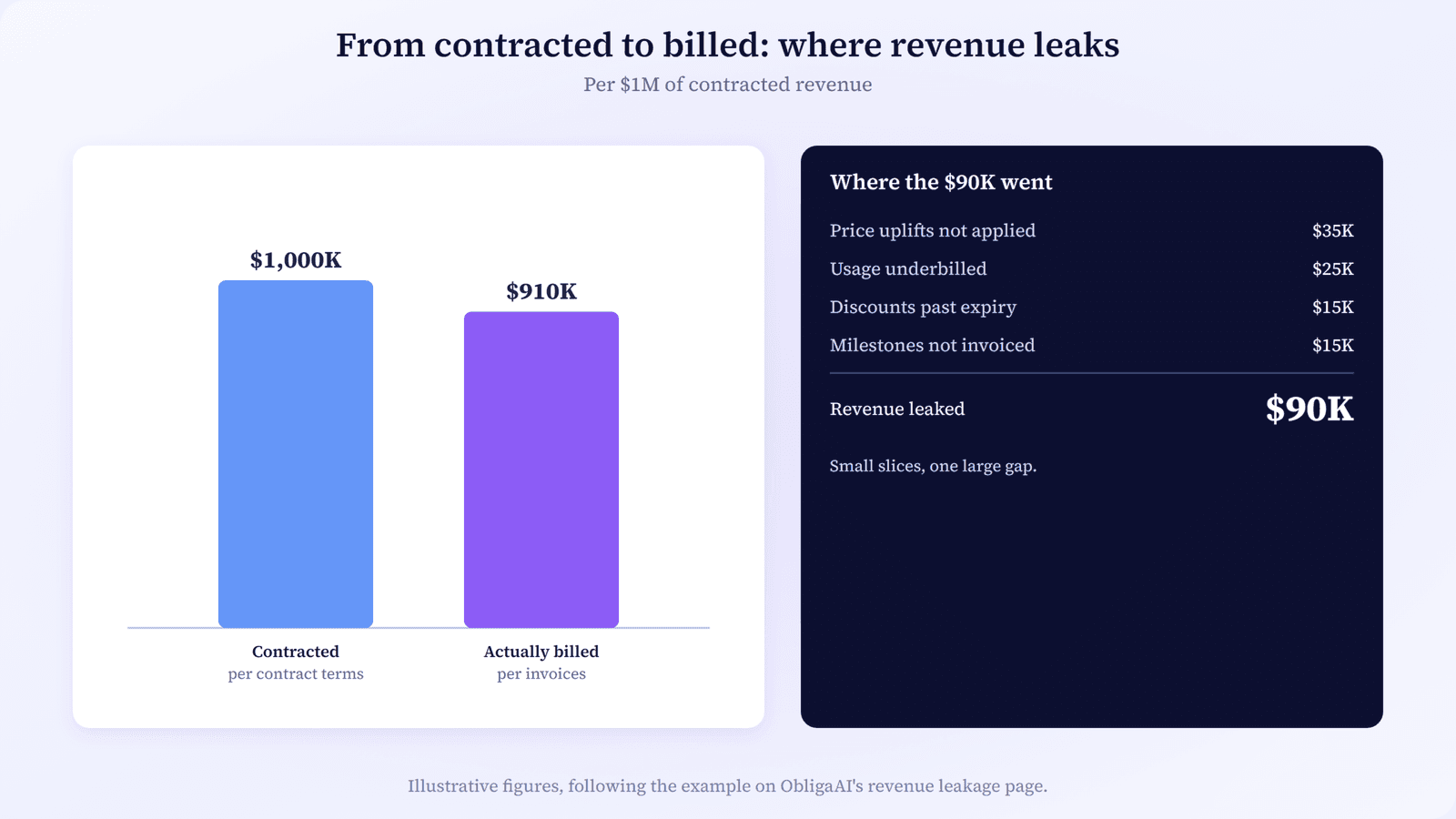
Revenue leakage clusters in a small number of contract terms. The illustrative picture below follows ObligaAI’s own example of $1 million in contracted revenue: four common leaks each take a slice, and the business bills $910,000.
- Price uplifts not applied: $35,000.
- Usage underbilled: $25,000.
- Discounts past expiry: $15,000.
- Milestones not invoiced: $15,000.

None of the four is large on its own. Together they are 9% of contracted revenue in this illustration. The pattern is familiar from pricing research. McKinsey’s study of the pocket price waterfall described a lighting supplier whose invoice prices averaged 32.8% below standard list prices, with further off-invoice deductions on top. The lesson for contracts is the same: value slips away in layers, and each layer looks small until you add them up.
The full list of places to look is longer than four:
- Price uplifts and escalators written into the contract but not applied.
- Usage and tiers billed from incomplete or stale usage data.
- Discounts that continue past their end date.
- Minimum commitments where the shortfall is never invoiced.
- Milestones delivered and accepted but not billed.
- Late payment interest and fees the contract or law allows but nobody charges.
- Amendments and renewals that change pricing but never reach the billing system.
The sections below take the first six in turn, each with a worked example. The seventh runs through all of them: most revenue leakage starts with a contract amendment or renewal that changed a number nobody updated.
Price Uplifts and Escalators Not Applied
Annual price increases are the most common source of revenue leakage in recurring contracts. They are agreed at signature, often fought hard for, and then forgotten because they only trigger once a year.
Fixed uplifts
Take the example from ObligaAI’s revenue leakage page. A customer agreement sets a monthly fee of $4,000 and states that on each renewal the fee increases by 5%, from the first day of the renewal term. The renewal date is 1 March. From that date the fee should be $4,200 a month.
The March invoice goes out at $4,000. So does every invoice after it. Each month is $200 underbilled. By the end of December, ten months have gone out at the old price, so $2,000 is lost that year, and the gap runs at $2,400 a year until someone notices.

Index-linked escalators
Many contracts link increases to an inflation index instead of a fixed percentage. These are easy to miss and easy to miscalculate. The US Bureau of Labor Statistics notes that CPI-U is used in most other escalation agreements, and recommends unadjusted data for escalation.
Suppose an illustrative $240,000 annual contract allows a CPI-U uplift at renewal, and the most recent figure is the 3.7 percent rise over the 12 months ending September 2026. The renewed fee should be $248,880. If billing simply rolls the old price forward, $8,880 a year leaks.
One timely caution: BLS cannot publish 12-month percent changes for October 2026 for most indexes, because October 2025 data were not collected. If your price escalation clause references the October figure, check its fallback wording before you calculate the uplift.
How to catch uplifts
- List every contract with an uplift or escalator, its trigger date, its basis (fixed or index) and any cap or notice requirement.
- Set a review before each trigger date, not after.
- Compare the first invoice after each trigger date with the uplifted price.
Usage and Tiered Pricing Underbilled
Usage-based pricing ties revenue to data that changes every month: API calls, transactions, seats, gigabytes, hours. That makes it powerful, and it makes it leak. See usage-based billing for the basics.
Where usage leaks
- Stale or partial usage feeds. Billing runs before the usage report is complete.
- Wrong tier. Usage crosses a threshold, but the billing system keeps the old tier.
- Uncounted products. A product added mid-term never gets metered.
- Manual overrides. A one-off credit or cap applied once and never removed.
A worked example
An illustrative contract includes 10,000 units a month in the base fee and charges $0.50 for each unit above that. The usage report for the month shows 14,200 units, so 4,200 overage units are owed, worth $2,100. The billing run used a partial feed showing 13,000 units and billed 3,000 overage units, worth $1,500. The month is underbilled by $600.
Repeated monthly, $600 becomes $7,200 a year from one customer. Usage leakage is rarely visible in a single invoice. It shows up when you reconcile usage reports to invoices line by line.
Discounts That Outlive Their End Date
Introductory, ramp and promotional discounts are common in enterprise deals. They are meant to end. Often they do not.
A worked example
An illustrative customer signs at a list fee of $10,000 a month with a 20% discount for the first 12 months, so it pays $8,000 a month in year one. From month 13 the fee should return to $10,000. The billing system was set up with $8,000 as the price, not as a discounted price with an end date, so month 13 goes out at $8,000 again.
The gap is $2,000 a month, or $24,000 a year, and it continues until someone reads the contract.
How to catch expired discounts
- Record every discount as a term with a start date, an end date and a condition, not as the price itself.
- Flag every discount that ends in the next 90 days.
- Check the first invoice after each end date.
Discounts can also be conditional: a lower rate in exchange for a volume commitment, a multi-year term or prompt payment. If the condition is not met, the discount may no longer apply. That is a contract question, so read the clause before you re-price.
Minimums, True-Ups and Milestones Never Invoiced
Some revenue only becomes billable when something happens: a commitment period ends, a usage count is reconciled, or a deliverable is accepted. These event-driven invoices are among the easiest to forget, because nothing in the normal monthly billing run creates them.
Minimum commitment shortfalls
An illustrative customer commits to a $120,000 annual minimum. By the end of the year, its actual spend is $95,000. The contract says the customer pays any shortfall at year end, so a $25,000 true-up invoice is owed. Nobody raises it, because the billing system only invoices actual usage.

The same logic applies to minimum purchase commitments and to license true-ups, where a customer has deployed more seats than it bought. See software license true-up.
Milestones delivered but not billed
Project and services contracts often bill on milestones. An illustrative $150,000 implementation has three milestones of $50,000 each: design sign-off, build complete and go-live. Design sign-off is accepted on 15 March and invoiced. Build complete is accepted on 30 June, but the acceptance email sits with the project team and never reaches billing. Go-live is still pending.

That is $50,000 of earned revenue sitting uninvoiced, and every week it waits is a week of cash the business does not have.
How to catch event-driven invoices
- Keep an obligation register of every event that should create an invoice: commitment period ends, true-up dates, milestone acceptances.
- Give each one an obligation owner who confirms the invoice went out.
- Reconcile acceptances and commitment periods to invoices every month.
How ObligaAI Helps You Bill What Your Contracts Say
Every example above has the same root cause: the contract says one thing, and nobody compares it with what was billed. ObligaAI’s revenue leakage product is built to make that comparison routine.
Three kinds of record go in. ObligaAI matches customer contracts, order forms, renewals and price lists against usage and delivery records and the invoices you raised. It runs three match streams: contract to invoice, usage to invoice and milestone to invoice.
The clause types that leak. It reads fees, escalators, usage tiers, discounts, minimums, milestones and renewal terms, the same terms covered in this guide.
Your clauses, interpreted. Each pricing promise becomes a plain-language obligation with a confidence score and a link to the exact passage. In the product’s own example, a clause raising a $4,000 fee by 5% at renewal is read as $4,200 a month from the renewal date, so an invoice at $4,000 after that date is flagged as underbilled by $200 a month.
One answer comes out. For each finding, ObligaAI shows the clause and the invoice, the shortfall in dollars, and a recommended action. You can set a tolerance per customer or organisation-wide, so nothing below a minimum amount is flagged.
Advisory first, finance approves. ObligaAI does not change your invoices. It flags the difference and the clause behind it, and your finance team decides what to correct and when. It works beside the billing and contract systems you already run.
Past underbilling too. You can start with a sample of contracts and recent invoices in a free trial and see what the comparison shows. Revenue leakage is one side of contract value leakage; the other side is overpaying suppliers. To see your own baseline, start free with a few contracts and invoices.
Late Payment Interest and Fees Left Uncharged
Revenue leakage does not stop at the invoice. Many contracts allow interest or fees on late payment, and many businesses never charge them. See late payment fee.
What the contract or law may allow
Start with your own contract: it may set an interest rate or a fixed fee for late payment. Where it does not, local law may provide one. In the UK, for example, the Late Payment of Commercial Debts (Interest) Act 1998 makes it an implied term in a contract to which this Act applies that qualifying debts carry simple interest. UK government guidance says statutory interest for business-to-business transactions is 8% plus the Bank of England base rate, and that you cannot claim statutory interest if the contract sets a different rate. You may also be able to claim a fixed sum for debt recovery costs: the guidance sets it at £100 for debts of £10,000 or more, and it can only be charged once for each payment. The base rate that applies to a given debt depends on the reference date, so check the guidance before you calculate.
A worked example
Take an illustrative £40,000 invoice paid 60 days late, using an assumed 12% annual rate (8% plus an assumed 4% base rate). Interest is £40,000 × 12% ÷ 365 = £13.15 a day, or about £789 for 60 days, before any fixed sum for recovery costs.
Whether you charge it is a commercial decision. Many businesses waive interest for good customers. The leakage is when nobody decides at all, because nobody tracked it. This is general background, not legal advice: rules differ by jurisdiction and contract, so take advice before relying on statutory interest.
How to Run a Revenue Leakage Audit
A revenue leakage audit compares a defined set of customer contracts with the invoices, usage and delivery records behind them. It follows three steps.

Step 1: Read the contracts
- Choose the population. Start with your top customers by revenue, plus every contract with uplifts, usage pricing, discounts, minimums or milestones.
- Gather the full set. Master agreement, order forms, renewals, amendments, side letters and price lists.
- Extract the billable terms. Fees, uplift dates and basis, usage rates and tiers, discount end dates, minimums, milestones, payment terms and late payment terms. Link each term to its clause.
Step 2: Match
- Contract to invoice. Does each invoice line use the right price for that date?
- Usage to invoice. Do billed units match the final usage report and the right tier?
- Milestone to invoice. Has every accepted milestone and every commitment period end produced an invoice?
- Payments. Were late payments charged interest or fees where the contract allows, or consciously waived?
Step 3: Act
- Validate each finding with sales, customer success and finance before contacting the customer.
- Decide the remedy: a corrected invoice, a catch-up invoice, or a commercial decision to waive.
- Fix the setup in the billing system so the same leak does not repeat: correct prices, add end dates to discounts, schedule uplift reviews, add event-driven invoice triggers.
How far back to look
Most audits look back 12 to 24 months. Older underbilling may still be recoverable, but contractual dispute windows, customer relationships and legal time limits all affect what is realistic. Agree the lookback with finance and legal before you start.
Recovering Underbilling Without Damaging the Relationship
Finding revenue leakage is the easy part. Asking a customer to pay more for a period that has already passed needs care.
Lead with the contract
Customers respond better to “Clause 7 sets the fee at $4,200 from 1 March” than to “we think we undercharged you”. Quote the clause, show the calculation and attach the invoices.
Separate the future from the past
There are two decisions, and they can be made separately:
- Going forward: correct the price from the next invoice. This is usually uncontroversial, because the contract is clear.
- Looking back: decide whether to bill the historical shortfall in full, in part, spread over time, or waive it in exchange for something else, such as an earlier renewal or a longer term.
Involve the account owner
Sales or customer success should know before the customer does. A catch-up invoice that arrives unannounced can damage a renewal worth far more than the shortfall.
Record the decision
Whatever you decide, record it against the contract: the finding, the amount, the decision, who approved it and why. That record is your evidence if the same question comes up at renewal or in an audit.
Measuring Revenue Leakage Over Time
Revenue leakage is worth measuring because small percentages carry large effects. McKinsey’s analysis found that, holding volume constant, a 1% price increase would lift operating profit by about 8% for a typical S&P 1500 company. Recovering revenue you already agreed works the same way: it falls almost straight to profit, because the cost of delivering it has already been paid.
Track a small set of measures:
- Billing accuracy rate: the share of invoices that match contract terms on first issue.
- Revenue leakage found: the dollar value of underbilling identified per period, by leak type.
- Revenue recovered: the value actually invoiced and collected after findings.
- Time to detect: how long after the trigger date each leak was found.
- Repeat leaks: findings in contracts that were already corrected once.
Over time, the goal is to move detection earlier, from an annual revenue leakage audit to a check on each invoice before it goes out.
The Limits of Fixing Revenue Leakage After the Fact
A periodic review recovers money, but it has limits worth stating plainly.
- Not every shortfall is recoverable. Customers may dispute old invoices, and some contracts limit how far back you can bill.
- Relationships set the ceiling. A strategic account may justify waiving a historical gap.
- Contracts are not always clear. Ambiguous uplift wording, missing amendments or conflicting order forms can make the right price a matter of interpretation. Outcomes depend on the contract wording and governing law; this guide is not legal advice.
- Data quality limits usage checks. If usage reports are incomplete, you cannot prove what was owed.
- One-off reviews go stale. Every renewal and amendment creates a new chance to leak.
The lasting fix is to make the contract-to-invoice comparison part of every billing run, so revenue leakage is caught before the invoice goes out, not quarters later.
Frequently Asked Questions About Revenue Leakage
What is revenue leakage?
Revenue leakage is revenue a business is entitled to under its contracts but does not invoice or collect. Common causes include price uplifts not applied at renewal, usage underbilled, discounts that continue past their end date, minimum commitment shortfalls and milestones that are never invoiced, and late payment interest left uncharged.
What are common revenue leakage examples?
A 5% renewal uplift never applied, so a $4,000 monthly fee stays at $4,000 instead of $4,200. A 20% first-year discount that keeps applying in year two. A $25,000 minimum commitment shortfall never invoiced. A $50,000 milestone accepted but not billed. Usage billed from a partial report.
How do you calculate revenue leakage?
For each contract, calculate what should have been invoiced under the current terms and compare it with what was actually invoiced, line by line and period by period. The difference is underbilling. Add uncollected amounts and uncharged late payment interest to get the full picture, and express the total as a share of contracted revenue.
What is the difference between revenue leakage and underbilling?
Underbilling is invoicing less than the contract allows. It is the largest component of revenue leakage, but revenue leakage is broader: it also includes revenue never invoiced at all, such as missed milestones or true-ups, and revenue invoiced but not collected, such as unpaid invoices or uncharged late payment interest.
How do you run a revenue leakage audit?
Choose a set of customer contracts, gather every amendment and order form, and extract the billable terms. Match them against invoices, usage reports and milestone acceptances. Validate each finding with the account team, decide whether to correct going forward, bill historical shortfalls or waive them, and fix the billing setup so the leak does not repeat.
Can you bill a customer for past underbilling?
Often, if the contract supports it and the customer agrees, though it depends on the contract wording, any dispute or invoicing time limits, and the governing law. Many businesses correct the price going forward and treat the historical shortfall as a separate commercial decision. Take advice before pursuing large or disputed amounts.
Which teams own revenue leakage?
Usually no single team, which is why it persists. Sales negotiates the terms, legal files the contract, billing sets up the invoices and finance closes the books. The most effective approach assigns an owner to each billable obligation and makes finance responsible for checking invoices against contract terms.
How can you prevent revenue leakage?
Record every billable term with its dates and conditions, not just the starting price. Review uplift dates, discount end dates, commitment periods and milestones before they trigger. Reconcile usage and acceptances to invoices monthly. Ideally, compare every invoice with the contract before it is sent.
Start Billing Every Dollar Your Contracts Allow
Revenue leakage is revenue you already won. It is written into your contracts as uplifts, usage rates, discount end dates, minimums, milestones and payment terms. It leaks because nobody compares those terms with the invoices, month after month.
Start with your top customers and every contract with an uplift, usage pricing, a discount, a minimum or a milestone. Extract the billable terms, match them to invoices and usage, and fix the billing setup behind each finding. Then move the check earlier, so the next leak is caught before the invoice goes out.
If you want that comparison done for you, ObligaAI reads your customer contracts, matches them against usage, milestones and invoices, and shows each shortfall with the clause and a recommended action, while your finance team decides what to change. Start free with ObligaAI (no credit card required), or start a conversation with the team about your contracts.