
TL;DR
- Start software renewal planning before the supplier’s quote arrives. Notice and reduction deadlines may come earlier.
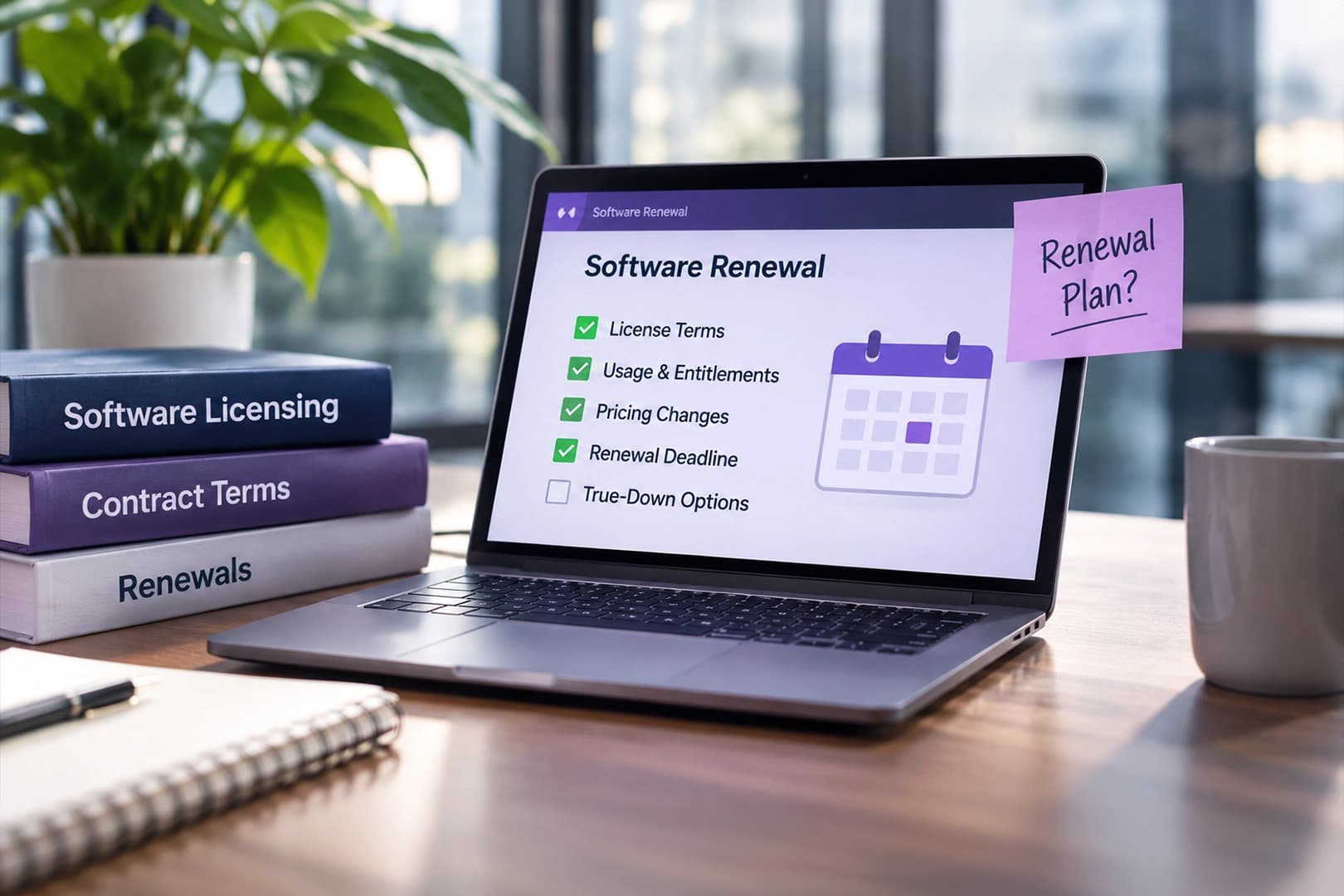
- Check pricing changes, renewal terms, true-down rights and cancellation windows. Monthly billing does not necessarily mean a monthly commitment.
- Match actual usage to the contract’s licensing rules. Unused licences do not automatically give you the right to reduce spend.
- Bring Finance, Procurement and IT together to confirm available options, negotiate changes and check the first post-renewal invoice.
- ObligaAI helps teams find relevant contract terms, obligations and dates with source references. Usage evidence still needs separate validation.
Software renewals are becoming harder to treat as routine purchases.
In Flexera’s 2026 State of ITAM survey, 48% of respondents said their organisation had received a software audit in the previous year. Forty-four percent reported spending more than $1 million on audits over the past three years. The survey covered 512 technology professionals, so these figures describe the respondents rather than every organisation.
At the same time, software pricing itself is becoming less predictable.
Zylo’s 2026 SaaS Management Index found that 78% of surveyed IT leaders had encountered unexpected charges tied to consumption-based or AI pricing in the previous 12 months. Its wider dataset covers more than 40 million SaaS licences, and the report says organisations leave an average of 36% of licences unused against recommended utilisation levels.
For Finance, Procurement and IT, the practical implication is simple: a software licence cannot be managed only at purchase.
The terms that matter at renewal may have changed long before the quote arrives.
Three software-licensing shifts worth tracking
1. Pricing changes may arrive at renewal
Microsoft announced in August 2025 that Online Services purchased through Enterprise Agreement and MPSA programmes would move to a consistent price across Price Levels A–D from November 1, 2025. The change applies at the customer’s next agreement renewal, or when certain new Online Services are added.
Microsoft also introduced new commercial Microsoft 365 pricing from July 1, 2026. Existing customers remain on their previous pricing until their next renewal after that date.
That makes the renewal date more than an administrative milestone. It can determine when a pricing change actually reaches the budget.
2. Usage-based pricing is creating new cost surprises
Software pricing is also moving beyond simple per-seat subscriptions.
Zylo reports that 78% of IT leaders surveyed experienced unexpected charges linked to consumption-based or AI pricing. The same index highlights unused licences as another persistent source of spend inefficiency.
These are two different problems:
- capacity you bought but do not use
- usage that costs more than expected
Both matter at renewal because the commercial terms determine what can actually be reduced, reassigned or renegotiated.
3. Licensing practices are receiving more scrutiny
Flexera’s 2026 report shows Microsoft remaining the most commonly reported software-audit vendor among respondents, while reported Oracle and Adobe audit activity also increased year over year.
Regulators are looking at the wider software market too.
On March 31, 2026, the UK Competition and Markets Authority announced a package of actions concerning cloud services and business software and said it intended to investigate Microsoft’s business-software ecosystem. The formal Strategic Market Status investigation opened on May 14. In October, the CMA issued a proposed decision to designate Microsoft with Strategic Market Status; a final decision has not yet been made.
For buyers, the useful response is not to predict what regulation will change. It is to know which commercial terms apply today.
The invoice tells you the charge. The contract tells you your options.
A renewal often begins when a supplier sends a quote.
By then, an important decision window may already be closing.
If you want to reduce seats, the relevant question is whether the agreement allows a true-down and when notice must be given.
If an audit is approaching, the contract determines the audit right, the measurement basis and the evidence that may be required.
If the business is considering another provider, termination rights, renewal language and data-export obligations become important.
Microsoft’s New Commerce rules illustrate why the detail matters. For certain licence-based subscriptions, a prorated cancellation window is available for seven calendar days after purchase or renewal, and that window does not reopen until the subscription renews into a new term.
A monthly invoice therefore does not necessarily mean a monthly right to reduce the commitment.
Build the renewal around the contract
A contract-led renewal begins before the supplier’s quote.
Start with four things:
1. The decision deadline
Find the notice, renewal, cancellation or reduction date that determines when action is still possible.
2. The rights in the agreement
Check whether the contract allows quantities to be reduced, licences to be reassigned, services to be terminated, or commitments to be changed.
3. The counting rule
Understand how the licence is measured: named user, device, processor core, consumption, minimum commitment or another mechanism.
4. The usage evidence
Bring in actual usage or deployment data that matches the contractual counting rule.
Usage data alone does not establish a right to pay less.
The agreement determines whether that usage can be turned into a commercial change.
Two ways to run a software renewal
Invoice-led renewal
The renewal quote arrives.
The team compares it with the previous bill.
Price becomes the main negotiation point.
Usage is reviewed late, if at all.
The contract is revisited close to the deadline.
The organisation may end up renewing the same quantity at a different price.
Contract-led renewal
The team identifies the earliest notice or reduction deadline.
It checks the rights to reduce, reassign, terminate or renegotiate.
IT adds reliable usage evidence.
Procurement enters the negotiation knowing which changes are contractually possible.
Finance checks the first post-renewal invoice to confirm that the agreed change was actually reflected in billing.
The difference is timing.
A contract-led renewal starts with the decision window rather than the supplier’s quote.
Is your next renewal ready?
Choose one software agreement renewing within the next six months and answer these questions:
- Can you find the signed agreement and all relevant amendments?
- Do you know the last date to reduce quantities or give notice?
- Do you know how the licence is counted?
- Do you have usage evidence that matches that counting rule?
- Do you know whether a pricing change applies at the next renewal?
Five yes answers means the team has a strong evidence base for the renewal.
Three or four means there are still gaps to close before the quote arrives.
Two or fewer means the first priority should be finding the deadline and confirming what the agreement actually allows.
Where ObligaAI fits
Software licensing is one of ObligaAI’s published use cases.
The platform is designed to help teams search contract terms, track obligations and key dates, and review software-licensing commitments such as purchased seats, renewal terms and usage-related questions. ObligaAI also provides source references so a user can inspect the contract language behind an answer.
For a renewal review, that can help a team answer questions such as:
- When is the reduction or notice deadline?
- Does the agreement permit a true-down?
- Which amendment contains the current pricing terms?
- How many licences were purchased?
- Which clause governs the renewal?
Usage and deployment data still need to be validated separately, and the team remains responsible for approving any commercial decision.
An unused licence does not automatically create a right to reduce spend. The contract determines what action is available and when.
The takeaway
Software renewals are easier to manage when the contract is reviewed before the quote arrives.
Pick one upcoming renewal.
Find the notice deadline.
Confirm the counting rule.
Compare the contractual commitment with actual usage.
Then enter the renewal conversation knowing which options are still open.
If you want to review software-licensing terms across your agreements, explore ObligaAI’s software-licensing use case.